The 4mm Brake Pad Rule Was Written for a Driver Who Doesn't Exist
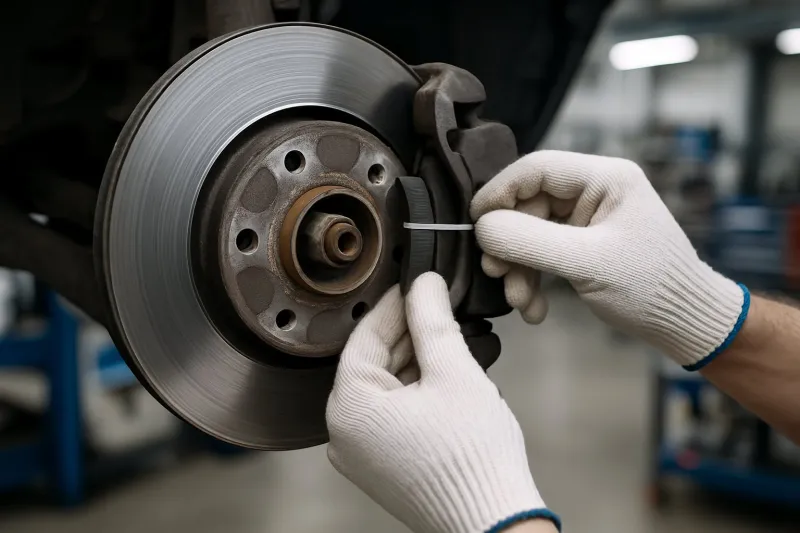
Photo: mechanic inspecting car brake pads close up, via www.brakepadboss.com
At some point, almost every driver gets the same speech from a mechanic or a quick-lube tech: Your brake pads are at 4mm — you should replace them soon. Maybe it's 3mm, maybe it's ¼ inch, depending on who's talking. The threshold varies slightly by source, but the logic is always the same: there's a number, and when you hit it, it's time.
The problem is that this advice was built around a hypothetical average driver living a hypothetical average driving life. And that driver doesn't actually exist.
Where the Number Came From
Brake pads have a wear indicator — a small metal tab built into the pad that makes a squealing noise when the friction material wears down to a point where replacement is necessary. That's the hard floor. The 4mm or ¼-inch recommendation exists as a buffer above that floor, giving drivers time to schedule a service before the metal-on-metal grinding starts.
The recommendation was essentially engineered around moderate driving conditions: mostly flat roads, moderate speeds, predictable stop-and-go patterns, and a temperate climate. It became universal because it's easy to communicate and easy to measure. Mechanics needed a number they could quote quickly during a multi-point inspection, and this one stuck.
But the engineering assumptions baked into that number don't apply equally to everyone.
How Driving Style Changes the Equation
Brake pads don't wear at a fixed rate. They wear in response to how hard they work, and that varies enormously from one driver to the next.
Aggressive drivers — people who accelerate hard and brake late — put dramatically more heat and friction into their pads than someone who coasts to a stop. The pad material degrades faster under repeated high-heat cycles, and the effective stopping power of a pad at 4mm isn't the same for a driver who's been cooking their brakes as it is for someone who barely touches the pedal.
Stop-and-go commuters in cities like Los Angeles, Atlanta, or Chicago face a different version of the same problem. Frequent partial braking — the kind you do in traffic, over and over for an hour — builds cumulative heat and wears the friction material unevenly. A pad that looks fine on a thickness gauge might be glazed or uneven in ways that affect performance before the numbers say it should.
The Mountain Driver Problem
If you live in or regularly drive through mountainous terrain — the Rockies, the Appalachians, the Sierra Nevada — the standard replacement threshold deserves real scrutiny. Long downhill stretches require sustained braking, which generates sustained heat. Heat is the enemy of brake performance.
At elevation, brake fade — the temporary loss of stopping power caused by overheated pads — is a real and dangerous phenomenon. A pad that's at 4mm in Denver and headed down a mountain pass is working in conditions that a pad at 4mm in suburban Ohio will never face. The number is the same. The risk profile is completely different.
Some mountain drivers and driving instructors recommend replacing pads earlier — at 5mm or even 6mm — specifically because the margin for error matters more when you're depending on your brakes to manage a sustained descent.
Why Mechanics Quote the Same Number to Everyone
This isn't a conspiracy, and it's not laziness. It's a structural reality of how service shops operate.
A technician doing a standard inspection has a few minutes to look at your brakes, measure the pads, and make a recommendation. They don't know your commute, your driving style, your weekend habits, or whether you spent last Sunday driving down a canyon road. The universal threshold is the only tool they have that works across all customers without requiring a detailed interview.
The 4mm rule is also defensible. If a shop recommends replacement at 4mm and you decline and then have a brake-related incident, the shop has documentation that they flagged the concern. The recommendation protects the shop as much as it informs the customer.
What Your Actual Situation Demands
So what should you actually do with this information?
Start by being honest about your driving life. If you're a hard braker, a heavy commuter, or someone who regularly drives in hilly terrain, consider replacing pads earlier than the threshold your mechanic quotes — not because the number is wrong, but because your driving is harder on brakes than the number assumes.
Pay attention to feel, not just measurements. Brake pads that are vibrating, pulling to one side, or taking longer to stop the car than they used to are telling you something a thickness gauge can't. Those symptoms matter regardless of what the numbers say.
Ask your mechanic about rotor condition alongside pad thickness. Rotors that are worn thin or have developed grooves can reduce braking effectiveness even when the pads themselves are technically within spec. The two components work as a system, and evaluating them separately gives you an incomplete picture.
And if you drive in genuinely demanding conditions — mountain roads, frequent towing, track days — consider stepping up to higher-performance brake pads designed for sustained heat. The stock pads on most passenger vehicles were spec'd for average conditions, and average conditions might not be yours.
The bottom line: The 4mm threshold isn't wrong — it's just incomplete. It's a starting point for a conversation about your brakes, not the final word on when they need attention. Your driving life is the other half of that conversation, and no universal number can have it for you.