You're Probably Paying for Premium Gas and Getting Absolutely Nothing for It
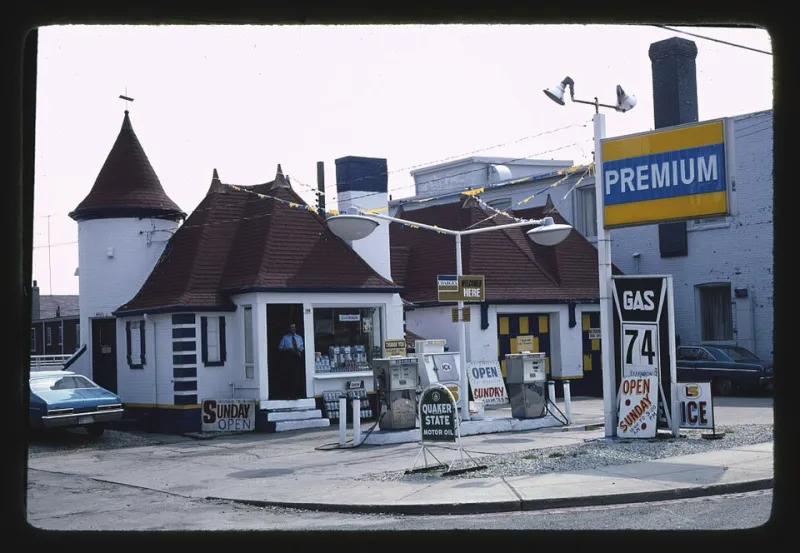
Photo: The Library of Congress, No restrictions, via Wikimedia Commons
The Gas Station Decision That Costs Americans Billions
Stand at any gas pump in America and watch people make their choice. A significant portion of drivers — surveys suggest somewhere between 15 and 20 percent — select the premium nozzle. Some do it because their car requires it. Many more do it because they believe it's better: cleaner, more powerful, gentler on the engine.
That belief is costing them real money. At a typical price difference of 50 to 70 cents per gallon, a driver filling a 15-gallon tank with premium instead of regular is spending roughly $500 extra per year — for a benefit that, in most cases, doesn't exist.
The gap between what octane ratings actually mean and what most drivers think they mean is one of the more durable misconceptions in American car culture. And like most durable misconceptions, it has a history worth understanding.
What Octane Actually Measures
Octane rating is not a measure of fuel quality, energy content, or cleanliness. It is a measure of a fuel's resistance to pre-ignition — the tendency of the air-fuel mixture in a cylinder to ignite before the spark plug fires.
This phenomenon, called engine knock or detonation, happens when the heat and pressure inside a cylinder cause spontaneous combustion before the controlled spark ignition occurs. You sometimes hear it as a pinging or knocking sound under load. It's mechanically stressful and, in severe cases, can damage engine components over time.
High-compression engines — the kind found in performance vehicles, turbocharged engines, and some luxury cars — generate more heat and pressure inside the cylinder, making them more susceptible to knock. These engines genuinely need higher-octane fuel to function as designed. The higher octane resists that premature ignition, allowing the engine's compression ratio to do its job without detonation.
A standard naturally-aspirated engine with a modest compression ratio doesn't generate enough cylinder pressure to trigger knock on regular 87-octane fuel. Putting 93-octane premium in that engine doesn't give it more power. It doesn't clean the injectors. It doesn't extend the life of anything. It just costs more.
The Knock Sensor Complication
Modern engines add a layer of nuance here that the fuel industry doesn't exactly advertise. Most contemporary vehicles are equipped with knock sensors — small piezoelectric devices that listen for the acoustic signature of detonation and feed that information to the engine control unit in real time.
When a knock sensor detects pre-ignition, the ECU automatically retards the ignition timing to compensate. This means that if you put regular gas in a car that recommends premium, the engine won't knock — it will simply adjust its timing to prevent knock, which slightly reduces power output and fuel efficiency in the process.
This is why manufacturers distinguish between "requires premium" and "recommends premium." A car that requires premium — certain Cadillac, BMW, and Porsche models, for example — is calibrated in a way where regular fuel will cause a meaningful performance penalty even with timing adjustments. A car that recommends premium will run fine on regular but won't deliver its peak performance numbers.
For most drivers in most vehicles, neither of those situations applies. Their car was designed and calibrated specifically for regular fuel, and premium provides no measurable benefit whatsoever.
How Premium Got Its Halo
The perception of premium fuel as superior product didn't happen by accident. It was cultivated.
In the 1970s and 1980s, as leaded gasoline was phased out, refiners needed to maintain octane levels through other means — including additives and refining processes that were genuinely more expensive. The price premium was initially justified by real production costs.
Over time, the marketing around premium fuel evolved to emphasize quality and performance rather than just octane chemistry. Phrases like "top-tier fuel" and "premium cleaning agents" entered the conversation. Advertising positioned premium gas as the responsible choice for drivers who cared about their vehicles.
The Top Tier gasoline certification program — which is legitimate and does relate to detergent additive levels — got conflated in many consumers' minds with octane rating, even though the two are separate things. Top Tier fuel is available at all octane grades. You can buy Top Tier regular 87-octane. The detergent additives that keep injectors clean are not exclusive to premium.
The One Actual Benefit Worth Knowing
Here's the honest nuance: for drivers with turbocharged engines that "recommend" rather than "require" premium, using premium fuel consistently may allow the engine to operate at its optimal timing map more often — which can translate to slightly better real-world fuel economy under certain driving conditions. In some turbocharged vehicles, the math can actually get close to a wash between the extra fuel cost and the efficiency gain.
This is genuinely worth calculating for your specific vehicle if you're a high-mileage driver with a turbocharged engine. Run premium for a tank, track your actual fuel economy, and compare it to a tank of regular under similar conditions. The result will tell you whether the premium is paying for itself in your specific driving situation.
For the vast majority of American drivers — those in naturally-aspirated engines with no turbocharger, driving vehicles that specify regular fuel — that calculation will never come close to breaking even.
What to Do at the Pump
Check your owner's manual. Not the fuel door sticker, which sometimes says "premium recommended" as a blanket statement — the manual, which will specify whether premium is required or simply recommended. If it says regular, use regular. If it says recommended, you can experiment and decide whether the performance difference matters to you. If it says required, use premium.
Don't use octane as a proxy for fuel quality. If you want cleaner fuel with better detergent packages, look for Top Tier certified stations — that designation applies across all octane grades and is what actually matters for long-term injector health.
The Takeaway
Octane is a technical specification for a specific engineering problem: preventing pre-ignition in high-compression engines. It is not a quality rating. It is not a performance booster for engines that don't need it. And it is not a cleaning agent. The premium fuel market has benefited enormously from the gap between what octane does and what drivers think it does — and that gap has been expensive for a lot of people who were just trying to take care of their cars.