Your Car's Engine Displacement Number Is a Regulatory Estimate — Not an Engineering Fact
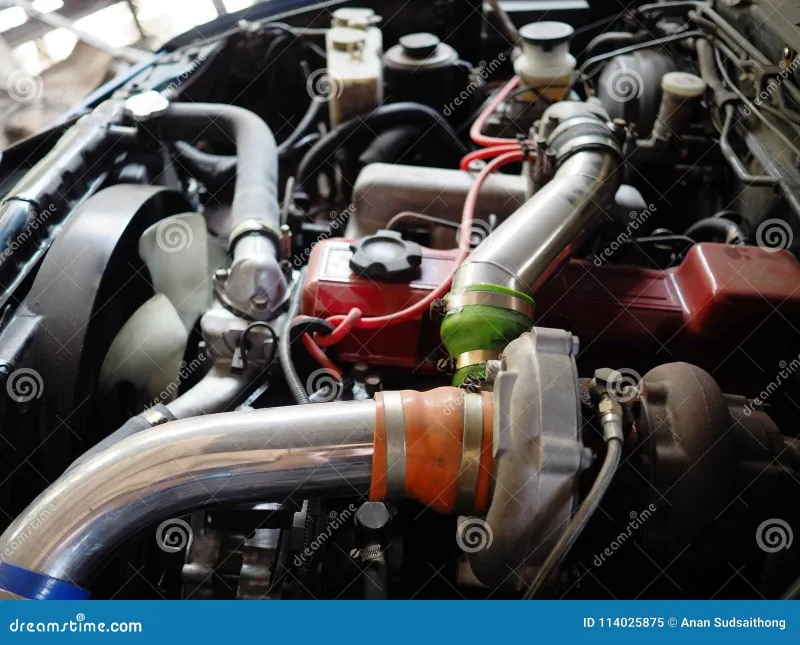
Photo: car engine close up turbocharger under hood, via thumbs.dreamstime.com
There's a number associated with your car that most owners treat as gospel — the engine displacement. The 3.5L on the sticker. The 6.2L in the brochure. The V6 or V8 designation on the badge. These figures feel like precise technical measurements, the kind of hard data that separates engineering from marketing.
They're not, really. They're rounded estimates built for a classification system that was designed long before modern engine technology existed — and the gap between the number on your registration and what's actually happening under your hood is bigger than most people realize.
How Displacement Gets Calculated
Engine displacement measures the total volume swept by all the pistons inside an engine's cylinders during one complete cycle. It's expressed in liters or cubic inches, and it's calculated using a formula based on bore (the diameter of the cylinder), stroke (how far the piston travels), and the number of cylinders.
So far, so precise. The problem is that manufacturers calculate and report this number using nominal dimensions — the intended design measurements — rather than the actual measured dimensions of every engine that comes off the line. Manufacturing tolerances mean that no two engines are exactly identical. The real displacement of a given engine might be slightly above or below the published figure, and that variation is built into the system by design.
This is why a "2.0-liter" engine is rarely exactly 2,000 cubic centimeters. Many are 1,984cc or 1,998cc or 2,012cc, depending on the manufacturer's rounding conventions and how they handle the tolerance stack. The figure on your registration is the marketing-friendly approximation, not a laboratory measurement.
The Turbo Problem Nobody Talks About
Here's where the gap between the number and the reality gets genuinely significant: turbocharged engines.
A turbocharged 2.0-liter engine forces compressed air into the cylinders, allowing them to burn more fuel per cycle than a naturally aspirated 2.0-liter ever could. The displacement figure — 2.0L — describes the physical volume of the cylinders. It says nothing about how much air-fuel mixture those cylinders are actually processing under boost.
In practical terms, a turbocharged 2.0-liter can produce power outputs that rival or exceed a naturally aspirated 3.0-liter or larger. Ford's EcoBoost engines are a well-known example. The 2.3-liter EcoBoost in the Mustang produces numbers that would have required a much larger displacement engine a generation ago. The displacement number classifies the engine for regulatory and registration purposes. It does not tell you how the engine actually performs.
Supercharged engines have the same issue, and so do engines with variable compression ratios — a technology found in Infiniti's QX50, among others — which can actually change their effective compression ratio while driving. The single displacement figure on the registration captures none of this.
Why the Registration Number Sticks Around
The displacement figure on your title and registration exists primarily for tax and regulatory classification purposes. Many states use engine size to determine registration fees, emissions testing requirements, and in some cases insurance rate categories. The figure needs to be simple, standardized, and stable — not technically nuanced.
This system was largely designed in an era when engine output was fairly predictable from displacement. A bigger engine made more power. A smaller engine made less. The number was a reasonable proxy for what the engine could do.
That relationship broke down as forced induction became mainstream. Today, a turbocharged 1.5-liter in a Honda CR-V and a turbocharged 1.5-liter in a performance-oriented application can produce wildly different outputs from nominally identical displacement figures. The classification system hasn't kept pace with the technology, and there's no strong regulatory incentive to overhaul it.
What This Means for Insurance and Resale
For most everyday drivers, the displacement figure on paper has limited practical impact. But it does affect a few things worth knowing about.
Insurance rate algorithms in some states use engine displacement as one factor in calculating premiums. A turbocharged small-displacement engine that produces large-displacement power might be rated at a lower risk tier than its actual performance warrants — or vice versa, depending on how the algorithm is structured. The number is an imperfect proxy for what the car can actually do.
Resale value conversations can also get muddied. Buyers who compare cars primarily by displacement are using a metric that doesn't tell the full story. A 2.0-liter turbocharged engine in one vehicle might significantly outperform a 2.5-liter naturally aspirated engine in another — but the larger number still reads as more engine to buyers who aren't looking deeper.
And if you're shopping for a used car and trying to compare performance across different models, displacement alone is one of the least useful data points available. Horsepower, torque, and real-world acceleration figures tell you far more about what the engine actually does than the liters stamped on the air intake cover.
The Number Isn't Useless — It's Just Misunderstood
None of this means the displacement figure is meaningless. It still tells you something about engine architecture, fuel consumption tendencies, and how the car fits into regulatory categories. A 6.2-liter V8 is a fundamentally different machine from a 1.4-liter four-cylinder, and the numbers reflect that difference accurately enough for most general purposes.
The issue is when buyers, sellers, or policy systems treat the displacement figure as a precise technical statement about what an engine is capable of. It was never designed to carry that weight. It was designed to fit into a box on a form.
The next time someone tells you a car's engine size like it explains everything about how the car drives — or how much it's worth — you'll know the real story. The number is a starting point. The engineering is a lot more interesting than that.